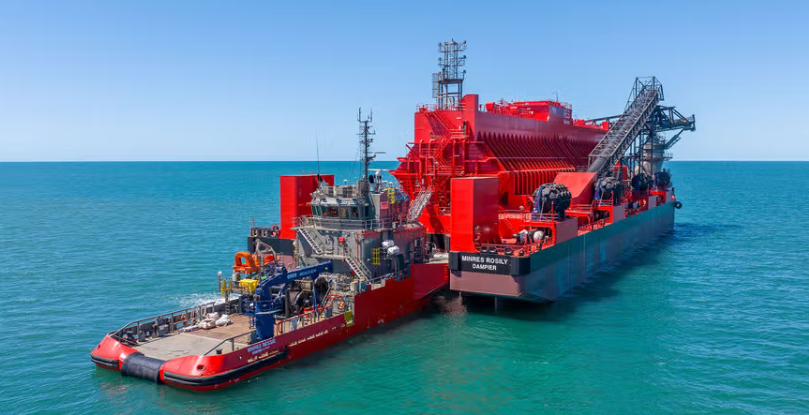
When the Asset Doesn't Move: ENVSonic on MRL Resources' 184m Stationary Processing Barges
It’s been about a year since the last of the four MRL Resources barges took up its operational position in Australian waters, and we’ve spent some of the months since reflecting on what the project taught us. It’s a useful one to share publicly.
Between 2022 and 2023, MRL Resources commissioned the build of four 184m stationary processing barges at COSCO Shipyard in China. The barges were delivered to Australia and now sit in permanent operational positions — processing assets, not transport assets. Stationary, in service, every day of the year.
That asset profile is one of the hardest fouling environments in commercial maritime, and it’s worth explaining why.
The biofouling case for stationary assets:
When fleet operators model antifouling, they usually model around in-service vessels at design speed. The economic case for a Newcastlemax bulker at 14 knots is well-understood. So is the case for a tug at 12 knots, an OSV at 10, a Ro-Pax ferry at 18.
The case for a stationary processing barge is fundamentally different. There is no design speed. There is no operational flow. The barge sits in warm coastal water, with sea-chest intakes drawing water continuously for the box coolers and the cooling systems supporting the processing operation. Every minute of every day, biological matter is settling, attaching, and accumulating on every wetted surface. Nothing about the operating profile discourages it.
In tropical and warm-temperate Australian waters, that environment goes from challenging to extreme. Fouling rates that would be slow on a moving vessel are accelerated on a stationary one. The box cooler that would last 18 months between cleanings on a vessel doing trades to Singapore is fouling visibly within months on a stationary barge in a warm coastal anchorage.
For MRL, the operational consequences would have been: reduced cooling performance on the processing operation, periodic in-water cleaning campaigns, ongoing biosecurity exposure under the Australian Biofouling Management Requirements, and a continuous fouling-driven cost line that would have compounded over the asset’s life.
Why ENVSonic was specified at the build:
ENVSonic was specified onto all four barges at COSCO before delivery. Box cooler protection on each unit. The system was running from the moment the barges were energized — through fit-out, sea trials, hand-over, the delivery passage to Australia, and the now-multi-year stationary deployment in Australian waters.
The result: continuous protection on the box coolers across the asset’s life, without periodic in-water cleaning campaigns, without the biosecurity inspection pressure that fouled niche areas would have triggered, and without the cooling-performance degradation that would have compromised the processing operation itself.
Why this matters for the wider fleet:
The MRL deployment is a useful case study because it captures a problem most operators don’t price in correctly. Stationary processing assets — FSO and FPSO units, floating processing platforms, mooring barges, transhipment platforms, accommodation barges — are the highest-fouling-risk asset class in commercial maritime by physics. They generate no operational flow. They sit in warm water continuously. The biosecurity exposure on the niche-area side is real and ongoing. And yet the antifouling investment per asset is often modeled against a moving-vessel benchmark, which under-prices the actual fouling rate.
ENVSonic’s ultrasonic protection is functionally agnostic to vessel speed. It works as well on a stationary asset as on one running flat out. For owners deploying long-life processing infrastructure into warm-water locations, the economic case is straightforward: continuous ultrasonic protection across the asset’s life is materially cheaper than the alternative of periodic in-water cleaning, ongoing biosecurity exposure, and degraded cooling performance.
What’s next:
The MRL deployment sits within a broader installed base of more than 1,000 vessels and assets protected by GLOBAtech’s ENVSonic and predecessor H2oBioSonic platforms over 17 years — across 14+ countries, and across every major commercial vessel class as well as stationary processing assets.
For shipowners, processing operators, and shipyards considering similar specifications on newbuilds or stationary infrastructure, GLOBAtech is now actively expanding its OEM and shipyard integration channel — including an ongoing partnership with WEKA Marine for box-cooler integration, and active proposals at Cochin Shipyard, AFAI Shipyard, INCAT, and others.
CONTACT: Operators interested in stationary-asset protection — barges, FSO/FPSO, floating processing, accommodation platforms — can reach our team via the contact form. Existing customers across PSA Marine, Bourbon Offshore, MRL Resources, Sealink, and others are happy to be referenced under existing relationships.