
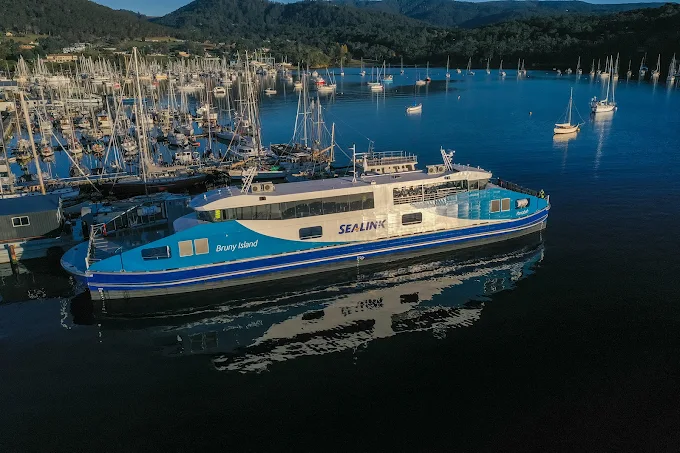
When Sealink commissioned two new Incat Crowther Ro-Pax ferries to operate the Bruny Island route, ENVSonic was not in the original specification. The vessels went into service, the route ran on schedule, and from the outside everything looked as it should.
About a year into service, the picture changed. The ferries started developing biofouling growth at a rate that conventional antifouling approaches weren’t holding back. Sealink reached out to GLOBAtech to see whether we could help.
We could. We did. And the story is worth telling because it captures a problem more ferry operators run into than the marketing literature would suggest.
Why ferry fouling is its own category:
Ro-Pax ferries on short inter-island routes face an antifouling challenge that doesn’t fit the templates derived from deep-sea shipping. Short routes mean low average speeds. Frequent port stays mean repeated warm-water exposure at the dock. Tight operational schedules mean unscheduled hull cleaning isn’t a cost line — it’s a service disruption that ripples through the entire timetable.
In Tasmanian waters, the seasonal fouling profile is more aggressive than many people expect. Summer water temperatures favour rapid biological accumulation. Winter doesn’t shut the problem down — it just shifts the dominant species. Across a calendar year, a ferry on a short Tasmanian route accumulates fouling faster than the same hull would on a long-haul deep-sea trade.
For Sealink, the operational consequence was real: declining hull condition, performance impact across the operating profile, and an antifouling strategy that needed to do more than what was already in place.
The retrofit deployment:
We worked with Sealink to design and install a comprehensive ENVSonic retrofit across both vessels — hull protection plus raw-water cooling system protection. The install was scheduled to minimize service disruption and was commissioned by our engineering team in operational sequence with the ferries’ service schedule.
The result, validated across the months since: fouling growth on the protected zones is now under continuous, in-service control. Operations have stabilized. The retrofit fixed the problem.
A note on retrofit vs. specification at build:
There is sometimes an assumption in our industry that ultrasonic antifouling is a build-spec decision — something you specify into a newbuild and live with. The Sealink work is a useful counter-example. Retrofitting ENVSonic onto a vessel already in service, including a vessel facing an active fouling problem, is straightforward. The technology is fundamentally compatible with retrofit deployment, and the operational benefit can be commissioned and validated without the vessel ever leaving service for an extended period.
For any ferry operator, OSV operator, or commercial workboat operator currently running into fouling growth that conventional approaches aren’t keeping up with — the Sealink story is a useful one to look at.
A broader Australian commercial pattern:
The Sealink deployment sits within a wider Australian commercial Ro-Pax and ferry installed base, alongside other Tasmanian operators, Port of Brisbane workboat protection, Australian box-cooler and keel-cooler installations, and ongoing dialogue with INCAT on a 130m ferry currently in active proposal.
Australia is one of our home markets — both as a regulatory environment that takes biofouling seriously (the Australian biosecurity regime is one of the most stringent in the world) and as an operational environment where the case for ultrasonic protection is unambiguous.